
Last week, I learned that Amazon has started scraping the e-commerce shops of a large number of independent retailers. Without permission, they are pulling product listings from our websites and displaying them on Amazon.
If you search Amazon for Dream Maker Creative (the crafting business I run along side of Harbor Reach), all of my craft kits and some of my handmade and resale products appear. In the desktop web interface, it looks fairly harmless. Beneath the product image and title is a “Shop Direct” button that links back to my website.
But if you use the Amazon app, it’s a very different experience.
Instead of a “Shop Direct” button, shoppers can click “Buy it for me” and let an AI bot handle the purchase. Amazon generates a proxy email address on their own domain, replaces the customer’s real email, and passes along the customer’s billing and shipping information to the merchant.
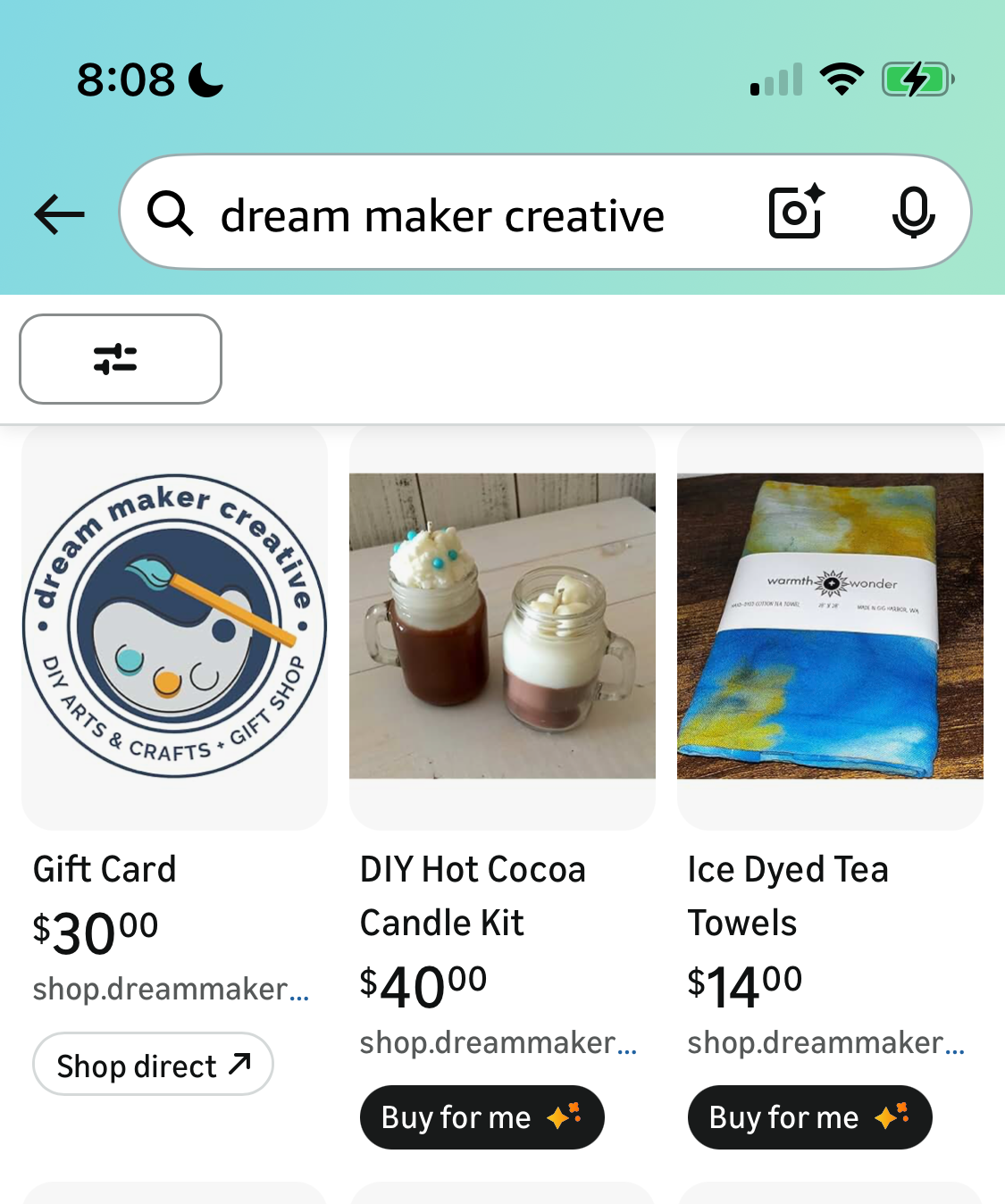

On paper, I still get paid. According to Amazon’s fine print, the customer is technically subject to my shipping and return policies. But Amazon has inserted itself as a middleman, stripped away my ability to communicate directly with that customer, and limited the transaction to a single item. The relationship ends there.
When I explain this to people who don’t run small businesses, many think it sounds like a good thing. After all, it’s a sale I might not have gotten otherwise.
Most small business owners feel very differently.
Those of us who have lived through platform rule changes, commission creep, and shifting terms know exactly where this tends to lead. I’ve been down this road before, and I can’t shake the feeling that it’s happening again.
Years ago, I sold subscription craft kits through a platform called Cratejoy. For a monthly fee, I could list my subscriptions in their marketplace. When someone purchased, Cratejoy earned a commission. At first, I had access to customer information and could integrate with my email marketing software.
Over time, that changed.
Cratejoy raised commissions, removed my ability to contact customers directly by email, stopped sending renewal reminders, opted me into sales and promotions without my consent, and became increasingly unresponsive to support requests. By the time things got truly problematic, roughly 70 percent of my customers were coming through their platform.
I tried to convert customers to buying direct by including postcards and incentives in their kits, but most preferred the convenience of the marketplace and stayed put. And those commissions were for life. While I believe it’s fair for a platform to earn a commission on an initial sale, it was my work and my product quality that earned repeat business.
I was never able to get out from under that platform. Eventually, I stopped accepting new customers and allowed subscriptions to expire rather than trying to renew them.
I know many makers who sell through Etsy have experienced similar patterns. Increased fees, forced advertising programs, reduced support, and in some cases, stores being shut down without warning or recourse. Many long-time sellers with strong sales histories and excellent reviews were suddenly gone.
That kind of risk is devastating for a small business.
So how does this relate to Amazon?
Amazon is strategic, and this feels like a long game. AI-powered purchasing is currently framed as a “free” feature. But once a meaningful percentage of a business’s sales flows through Amazon, they are in a position to exert control. New rules. New commissions. Participation requirements.
And perhaps most importantly, Amazon owns the customer relationship. Customers who value convenience are unlikely to convert to buying direct later, just as my Cratejoy customers didn’t. Add to that the expectation of free and fast shipping and extremely flexible return policies, and you have a recipe for serious strain on small businesses.
Even if a business technically sets its own policies, how many customers are realistically going to pause, leave Amazon, and carefully read the terms on an independent website? This is why I’m deeply uneasy about the broader push toward agentic AI in commerce. I’ve contacted Amazon to request that my products be removed from this program, but so far, nothing has changed.
The hard lesson I’ve learned is this: more sales are not always a good thing. Not when they come from the wrong channel, not when they strip away customer relationships, and not when platform fees and policy mismatches quietly erase the profit that made the sale worthwhile in the first place.
At the moment, the only recourse Amazon has offered is to email brandsdirect@amazon.com to request removal from the program. Some merchants have reported success with this approach. Personally, I have not. My products are still appearing, despite submitting an opt-out request.
It’s also important to note that switching platforms is unlikely to solve the problem. Merchants using Wix and Square are reporting the same scraping behavior, so this does not appear to be limited to any one e-commerce provider. In theory, WooCommerce sites could block Amazon traffic at the server level using .htaccess, but it’s unclear what unintended consequences that might have. Blocking a major crawler could have ripple effects on search visibility or other integrations, and most small businesses cannot afford to experiment blindly with those kinds of changes.
This is not an isolated issue, and it’s not going away quietly.
I plan to write a follow-up post about Shopify’s own agentic AI integration, scheduled to roll out on January 26. Shopify has stated that merchants will be able to decline participation, and I want to see how those opt-out options actually work in practice before commenting further. After years of watching platforms say one thing and do another, I’m waiting for evidence before forming an opinion.
For now, this feels like a moment where small businesses need to pay close attention. Convenience-driven AI tools may sound helpful on the surface, but when they remove control, customer relationships, and margin, they stop being tools and start becoming liabilities.